The new season's planting will be happening soon. The garden will be hungry for new seeds the last week February / first week March. We're going to order most of them from a very special small seed company called
J.L. Hudson, and also get some additional seeds from a lovely big seed company called
Seeds of Change. Seeds of Change are the people who also make organic pasta sauce and stuff, but originally they started out as a pioneering organic seed farm.
Clay and I had a good look through the seeds available at
jlhudsonseeds.com and also at
seedsofchange.com as these companies are owned by two couples who are my friends Sheri and David, and Howard and Nancy.
Sheri and David have lived in an old bus in the Santa Cruz mountains near Palo Alto in Northern California for the last thirty years. They have a profound knowledge of organic farming, heirlooms, the politics of food and also about local Californian growing techniques. Howard and Nancy are also totally rad and live in Northern California. Howard was Martin Luther King's personal assistant and Nancy was on Ken Kesey's bus. They have an amazing seed bank. Actually, I'd love to introduce these two couples to each other sometime. Maybe I'll get to do this in the next few weeks. Hmmm...
Anyway, more importantly, Clay still has saved a lot of the following kinds of seeds from last year, either that he's collected from our own garden's plants going to seed, or from packets that are still here. So he's made sure we have plenty of the following ready to go:
bell pepper
jalapeno peppers
carrots
corn (sweetcorn)
cilantro coriander
lettuce
onion
He also has a fair amount of:
pumpkin - one variety
melons - water, honeydew and cantalope
eggplant (aubergine)
radish
arugula (rocket)
sunflowers
poppies
We've gone through
David and Sheri's list, and this is what we like the look of in addition to Clay's seeds:
Amaranth - Polish
Basil - dark opal; and large sweet
Bean - rattlesnake
Beet - Bull’s blood (beetroots)
Broccoli de Rapa
Burdock (arctium), Great
Cress
Celery Giant red mix
Chrysanthemum Parthenium
Corn, bloody butcher (sweetcorn)
Corn salad (mache / lamb's lettuce)
cucumber, A & C pickling
huazontle
kale - russian red
kale - nero de philo
kohlrabi - early purple Vienna
Lavandula Stoechas (French Lavender)
okra - star of david (ladies' fingers)
parsley - common or plain leaf
pea, dwarf grey sugar (mange touts)
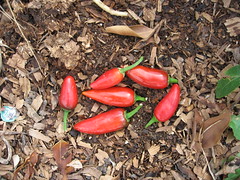
pepper, Habanero
pepper, Anaheim
radish, edible-podded rat’s tail
sorrell
chives
ground cherry (psyllius)
orach, aurora
purslane, golden
quinoa, cherry vanilla
sorghum, black and white
purple goosefoot tree spinach
squash, cucuzzi caeavazzi
Swiss chard, five color silverbeet
turnip, seven top
watermelon, orangeglo
We're also really keen to have a few more beneficial flowers, preferably ones we can eat in salads as well. So here's a couple of collections we like the look of from
Howard and Nancy's list:
Butterfly garden seed collection
Nasturtiums mix
I am so excited about this coming season... lots of seeds to sow.
Posted on 11th February 2007 by Ysanne | Permalink | 2 comments »
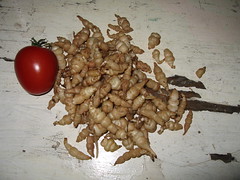
Help! I bought these delicious little tubers at the farmers' market yesterday, but have no idea what they're called! They are tiny tubers, between an inch and two inches long, and they look like little white maggots. I've shown them here with a particularly nice and ripe plum tomato to give an idea of the size.
These little tubers can be eaten raw, and taste a bit like Jerusalem artichokes or asparagus.
The farmer who sold them to me said they are called 'cosnes', pronounced 'cones', but when I Google this name, nothing comes up. He also said they taste delicious when sauteed in butter or olive oil, something which I have no doubt is entirely accurate.
Does anyone have any idea what these little beauties are called?
Posted on 5th February 2007 by Ysanne | Permalink | 11 comments »











 RSS Feed for Ysanne's blog


 Bookmark this page